SPANISH TO SAY · CATALAN TO READ
Getting around, and getting lost
Saying a Catalan street name out loud, asking the way, and reading the platform screen that is telling you your train is cancelled without using a word that looks like “cancelled”.
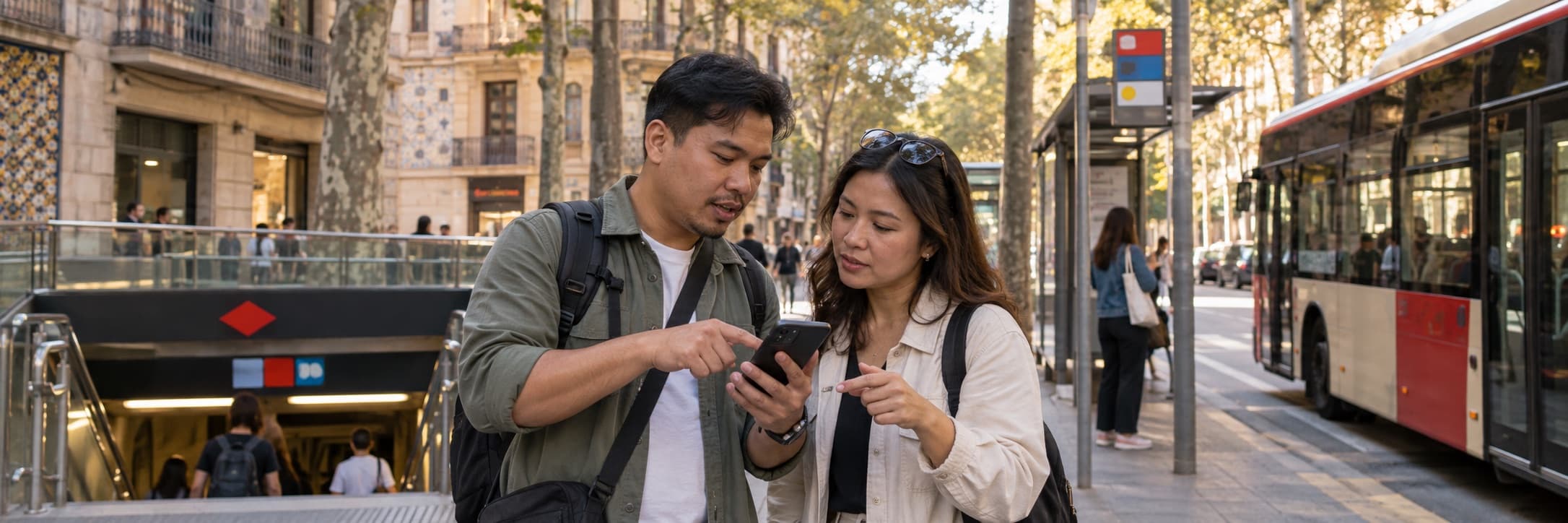
Getting around, and getting lost phrases
WORDS YOU SAY
Catalan place names, said out loud
You will mostly be reading Catalan, not speaking it. The exception is an address you have to say to a taxi or bus driver. Final -ig is “tch”, x is “sh”, ç is “s”, a final -r usually goes silent, and unstressed a, e and o soften towards “uh” and “u”.
Passeig de Gràcia
The main avenue through the Eixample.
Say it like: pa-SETCH duh GRA-si-uh
Plaça de Catalunya
The city's central square.
Say it like: PLA-suh duh ka-tuh-LOO-nyuh
L'Eixample
The grid district around Passeig de Gràcia.
Say it like: luh-SHAM-pluh
Carrer d'Aribau
A street — the pattern for saying any address.
Say it like: ka-REH da-ri-BAU
Sagrada Família
The basilica, and the neighbourhood around it.
Say it like: suh-GRA-duh fuh-MEE-li-uh
Sants
The main railway station.
Say it like: SANS
Montjuïc
The hill and park south of the centre.
Say it like: mun-zhu-EEK
Poblenou
The seaside district north of the port.
Say it like: po-bluh-NOU
WORDS YOU SAY
Asking the way
Stopping someone on the street to ask which way, how far, and whether it’s walkable.
Perdone, ¿cómo se va a la plaza Cataluña?
Excuse me, how do you get to Plaça Catalunya?
Say it like: …KO-mo se ba a la PLA-tha ka-ta-LU-nya
¿Dónde está la parada del autobús?
Where’s the bus stop?
Say it like: DON-de es-TA la pa-RA-da del au-to-BUS
¿Dónde está la boca de metro?
Where’s the metro entrance?
Say it like: DON-de es-TA la BO-ka de ME-tro
¿Está lejos?
Is it far?
Say it like: es-TA LE-khos
¿Se puede ir andando?
Can you walk there?
Say it like: se PWE-de ir an-DAN-do
¿Cuánto se tarda andando?
How long does it take on foot?
Say it like: KWAN-to se TAR-da an-DAN-do
¿Voy bien por aquí?
Am I going the right way?
Say it like: boy byen por a-KI
WORDS YOU SAY
On the bus or metro
Confirming a bus or a metro line goes where you think it does, and asking to be told when to get off.
¿Este autobús va a Nou Barris?
Does this bus go to Nou Barris?
Say it like: ES-te au-to-BUS ba a nou BA-rris
¿Esta línea va a Sants?
Does this line go to Sants?
Say it like: ES-ta LI-ne-a ba a sants
¿En qué parada me tengo que bajar?
Which stop do I have to get off at?
Say it like: en ke pa-RA-da me TEN-go ke ba-KHAR
¿Cuántas paradas faltan?
How many stops to go?
Say it like: KWAN-tas pa-RA-das FAL-tan
¿Tengo que hacer transbordo?
Do I have to change?
Say it like: TEN-go ke a-THER trans-BOR-do
¿Me avisa cuando lleguemos, por favor?
Can you tell me when we get there, please?
Say it like: me a-BI-sa KWAN-do ye-GE-mos, por fa-BOR
WORDS YOU SAY
When you are lost
The sentence that gets a stranger to stop and help you, and the follow-up questions once they do.
Me he perdido. ¿Me puede ayudar?
I’m lost. Can you help me?
Say it like: me e per-DI-do. me PWE-de a-yu-DAR
Busco esta dirección.
I’m looking for this address. (show your phone)
Say it like: BUS-ko ES-ta di-rek-THYON
¿Me lo puede señalar en el mapa?
Can you point it out on the map?
Say it like: me lo PWE-de se-nya-LAR en el MA-pa
¿Es por aquí?
Is it this way?
Say it like: es por a-KI
¿Sabe dónde está esta calle?
Do you know where this street is?
Say it like: SA-be DON-de es-TA ES-ta KA-ye
¿Dónde está la parada de metro más cercana?
Where’s the nearest metro stop?
Say it like: DON-deh es-TA la pa-RA-da deh MEH-tro mas ther-KA-na
¿Me puede ayudar, por favor? No sé qué hacer.
Can you help me please? I don’t know what to do.
Say it like: …no seh keh a-THER
WORDS YOU SAY
What you will hear back
The directions you’ll hear back once you’ve asked — left, right, straight on, and how far.
Todo recto.
Straight on.
Say it like: TO-do RREK-to
A la derecha. / A la izquierda.
On the right. / On the left.
Say it like: a la de-RE-cha / a la ith-KYER-da
La segunda calle a la derecha.
Second street on the right.
Say it like: la se-GUN-da KA-ye a la de-RE-cha
Cruce la calle.
Cross the road.
Say it like: KRU-the la KA-ye
Está al final de la calle.
It’s at the end of the street.
Say it like: es-TA al fi-NAL de la KA-ye
Al lado de… / Enfrente de…
Next to… / Opposite…
Say it like: al LA-do de / en-FREN-te de
Coja la línea tres.
Take line 3.
Say it like: KO-kha la LI-ne-a tres
Está a cinco minutos.
It’s five minutes away.
Say it like: es-TA a THIN-ko mi-NU-tos
WORDS YOU SAY
When something has gone wrong
A lost wallet or a robbery is not just a personal disaster — it’s paperwork, and the first stop is the Mossos d'Esquadra.
Se me ha perdido la cartera.
I’ve lost my wallet.
Say it like: seh meh a per-DEE-do la kar-TEH-ra
Me han robado.
I’ve been robbed.
Say it like: meh an ro-BA-do
Quiero poner una denuncia.
I want to file a police report.
Say it like: KYEH-ro po-NER OO-na deh-NOON-thya
1 source · checked September 2026
WORDS YOU READ
Words on a platform, a screen and a disruption notice
Platforms, screens and disruption notices write to you in Catalan too, the same as the Ajuntament and the Generalitat — you read Catalan here, you speak Spanish everywhere else. Three operators, three vocabularies: TMB, Rodalies and FGC each write their own word for the same event, and the word that matters most is the one that never looks like "cancelled".
andana
platform
Where you’ll see it: Station signs, screens, announcements
via
track number
Not the same as andana. The via is which track the train uses; the andana is where you stand. FGC announces the via by screen and loudspeaker.
Where you’ll see it: Rodalies and FGC screens and announcements
direcció / sentit
direction of travel, named by the last station on the line
TMB uses both words for the same thing — andana direcció Hospital de Bellvitge, escala mecànica d'andana en sentit La Pau. Learn the two end stations of your line. That is how every platform is labelled; there is no "northbound".
Where you’ll see it: Metro platform signs, escalator signs, live alerts
enllaç
the interchange — the passage between two lines
The word you follow to change lines.
Where you’ll see it: This is the printed sign. Enllaç tancat; el passadís d'enllaç entre l'L1 i l'L5; on the bus map, Enllaç o proximitat amb Rodalies.
transbordament
changing services, as a fare event
The money word, not the sign word. It tells you when you must re-validate.
Where you’ll see it: Fare pages: cal validar el títol de transport en cada transbordament.
accés · vestíbul · sortida
entrance · concourse · exit
Eixida is Valencian and does not appear in Barcelona.
Where you’ll see it: Station signage; alert headers read Accés tancat.
Sortida al carrer · Sortida d'emergència
exit to the street · emergency exit
Sortida al carrer is the one that gets you out of the station; a plain Sortida inside a station may only take you to another platform.
Where you’ll see it: The physical cartells named in TMB’s easy-read guide.
bitllet · bitllet senzill
ticket · single ticket
Where you’ll see it: Machines, the app
validar · validadora
to validate · the validating machine
An unvalidated ticket is no ticket. Some stations validate on the way out as well as in.
Where you’ll see it: Gates, on-board machines, validadores de sortida at some Rodalies stations
cancel·lar (el títol / el bitllet)
to validate your ticket
A trap. In Catalan transport this means validate, not cancel. A ticket described as cancel·lat en origen is a ticket that was correctly validated.
Where you’ll see it: Cal cancel·lar un títol de viatge vàlid cada cop que s'accedeix al metro o al bus.
corona · zona · tarifa
fare ring · zone · fare
A ticket for the wrong corona is invalid.
Where you’ll see it: Ticket machines, the fare map
feiners / laborables
working days
Same column, three languages — which is why Catalan pages say feiners and Spanish-language ones say laborables. On TMB this means Monday to Friday; Saturday has its own column.
Where you’ll see it: TMB’s printed timetable header reads Feiners | Laborables | Workdays.
festius · vigílies de festius · festius intersetmanals
holidays · the evening before a holiday · midweek holidays
A midweek holiday runs the Sunday service.
Where you’ll see it: Timetable columns
no circula
this train is not running — cancelled
This is the word, not suprimit or cancel·lat. Across 104 unique Rodalies incident texts archived 2010–2026, suprim* and cancel* appear zero times. If you are waiting for a word that looks like "cancelled", you will wait through your own train.
Where you’ll see it: Rodalies’ real-time feed and app: "El tren 15840 Barcelona-Sants 19:16h – Figueres 21:26h avui excepcionalment no circula per incidència tècnica en el propi tren."
no prestarà servei · els trens no circularan · s'interromp la circulació
the line will not run · trains will not run · circulation is suspended
Bigger than one train. Expect servei alternatiu per carretera and add an hour.
Where you’ll see it: Rodalies notices, for a whole line rather than one train
supressió de trens
cancellation of trains
Legal register, not a screen. You meet it when claiming compensation, never while waiting on a platform.
Where you’ll see it: Rodalies’ Condicions d'ús only
no pararan a… (Rodalies) · no fa parada (FGC) · no s'atura a… (TMB)
does not stop there
Three companies, three wordings, one meaning. Learn all three or you will miss the one your operator uses. Rodalies’ positive form is efectuarà parada a.
Where you’ll see it: Notices and announcements — each operator uses its own phrase
no admet passatgers · fora de servei · final de línia
not taking passengers · out of service · end of the line
The three reasons a train sitting on your platform will not take you.
Where you’ll see it: FGC platform announcements
demora (Rodalies) / retard (FGC, TMB)
delay
Rodalies says demora in real time and reserves retard for the compensation document (Justificants de retard). A reader scanning a Rodalies screen for retard will not find it.
Where you’ll see it: "circula amb 20 minuts de demora"
incidència · incidència tècnica · afectació
disruption · technical fault · service impact
The operators’ own words. Rodalies specifically avoids avaria, writing incidència tècnica en el propi tren or incidència a la infraestructura.
Where you’ll see it: TMB Estat del servei; Rodalies delay certificates
modificació del servei · servei alternatiu per carretera · restabliment parcial del servei
service change · replacement buses · partially restored
Per carretera means you are getting a bus instead of a train. Allow much more time.
Where you’ll see it: Real Rodalies disruption notices
avaria · «avariada»
breakdown · broken down
TMB’s own easy-read guide describes the sticker. Feminine, agreeing with porta.
Where you’ll see it: A red sticker on a Barcelona metro lift door; FGC’s printed station Avís posters ("a causa d'una avaria… romandrà fora de servei")
pròxima parada (spoken) · pròxim metro (platform screen) · propera parada (in-car screen)
next stop · next train · next stop
Two words for the same thing, and which one you meet depends on whether you are listening or reading. TRAM uses propera throughout.
Where you’ll see it: All three inside TMB, by channel
talls de línia
line closures
Where you’ll see it: In-car screens
canviar d'andana · en sentit contrari
change platform · in the opposite direction
The recovery phrase. If you overshoot your stop, this is what you do and what the signs and staff will say to you.
Where you’ll see it: TMB’s easy-read guide
justificant d'incidència (TMB) / justificant de retard (Rodalies)
official proof of a delay
Download it. It is what proves to your employer why you were late.
Where you’ll see it: TMB Sol·licita justificant d'incidència; Rodalies publishes daily certificates
Nitbus
the night bus network
When the metro closes, this is how shift workers get home.
Where you’ll see it: Stops, timetables
T-casual / T-usual
10 journeys / unlimited month
T-10 no longer exists.
Where you’ll see it: Ticket machines
títol de transport
fare product
Where you’ll see it: Machines, fares page
ascensor fora de servei
lift out of order
Matters with a pushchair.
Where you’ll see it: Station notice
21 sources · checked September 2026
- TMB official easy-read metro guide69 pp., lectura fàcil — the cartells, the «avariada» sticker, transbordament, canviar d'andana, en sentit contrari, what each screen shows
- TMB, Estat del servei de metro
- TMB live metro alert feedendpoint and public keys published in that page’s source — andana direcció…, Enllaç tancat, Accés tancat
- TMB, HorarisFeiners | Laborables | Workdays, vigílies de festius, Nitbus
- TMB, Com es viatja en metro
- TMB, Consells d'ús i convivènciaCal cancel·lar un títol de viatge vàlid cada cop que s'accedeix
- TMB, fare-zone mapvalidar el títol en cada transbordament
- TMB, bus network map legendEnllaç o proximitat amb Renfe / Rodalies / TRAM
- TMB, Bitllets i tarifesbitllet senzill, corones
- TMB, Pla director d'accessibilitat universalascensors fora de servei
- Rodalies real-time incident feeddeclared access point for the Generalitat open dataset Estat del servei de Rodalies de Catalunya — source of no circula
- Rodalies, Condicions d'ússupressió de trens, validadores de sortida
- Rodalies, Justificants de retard
- Rodalies, a real delay certificateuna incidència tècnica d'un tren
- Rodalies, Estat del servei
- Rodalies, títol de transport cancel·lat en origen
- Rodalies departures API speccarries an unrendered trainCancelled boolean
- FGC FAQno admet passatgers, fora de servei, final de línia, no fa parada
- FGC FAQ, track number announced at the station
- FGC Sí Civisme platform postersL'andana no és una paperera
- FGC printed station notice using avaria